
San Antonio Resident Lookup Records
The first choice depends on what needs confirmation. Bexar Central Appraisal District, or BCAD, records a parcel owner, mailing address, situs address, legal description, values, and property identifiers. That is not an occupancy statement. The Bexar County Clerk index records party roles, an instrument, date, and legal description. Courts identify cases and parties, while the individual voter form reports only its stated registration and precinct information. City and state vital custodians handle different events and eligibility rules. Historical directories document an edition-specific address association.
| Record | What It Confirms | Where | Access |
|---|---|---|---|
| BCAD parcel | Owner, mailing and situs fields, legal description | BCAD property and map search | Appraisal snapshot, not occupancy proof |
| County recording index | Recorded parties, instrument date, legal description | Bexar County Clerk Official Public Records | Copy and image rules vary by collection |
| Court case | Case number, party type, status, filing and events | Tyler, District Clerk, or Municipal Court | Protected material and result caps apply |
| Voter record | Registered address, precinct, election information | Bexar lookup or VoteTexas route | Exact fields and protected-address rules |
| Vital record | Event lead or public historical index | City registrar or Texas DSHS | Recent certificates require eligibility and ID |
| Historical directory | Name, address, trade, phone, or business detail by volume | SAPL, SAGHS, FamilySearch, Trinity | Patchy years and changed streets |
Use each label as the custodian uses it. A record can be an owner, a recorded party, a registered voter, a directory entry, a licensee, or a custody record. Combining those terms into a generic resident label hides the difference between the systems.
Verify a San Antonio Resident Record
For a same-name problem, anchor the search to a stable clue before opening several indexes. A case number, instrument number, property ID, or VUID is stronger than a name alone. A full name with a middle initial, an event date, an address, a legal description, or a court location can narrow the record, but protected details should not be copied into notes. When two sources conflict, retain both dates and roles rather than choosing the newer-looking field without its source context.
- Identify the question: recorded land role, court case, voter registration, vital event, historical address, credential, or state custody.
- Use BCAD by name, address, or property ID when a parcel is the starting point. Record its owner, situs, mailing field, legal description, and identifier as separate facts.
- Search the County Clerk by party, grantor or grantee, property address, legal description, instrument number, recorded date, and department when a recording needs confirmation.
- Compare a court or voter result with a second official source that matches the date, address, case number, or other allowed identifier.
- Request a plain or certified copy from the named custodian when the online display does not contain the needed official record.
- Docket
- A court's listing of case activity, hearings, and related events. It is not the same as every filing in the case.
- Index versus image
- An index identifies a record and its fields. An image is the underlying scanned document, which may have separate access rules.
- Certified copy
- A custodian-issued copy authenticated for the use that requires certification. Ask the clerk whether a plain, certified, sealed, or image-only copy is available.
San Antonio Court Record Checks
The Bexar New Justice Information Portal consolidates older case, fugitive, and bail-bond searches. Its public data does not require registration, but the county describes the display as a free convenience supplement that may be incomplete or not current. Search a case number first. For a name, the basic form accepts a name or case number, and the official guide describes Last, First Middle order. The portal accepts a wildcard, requires at least three last-name characters and four case-number characters, and limits results to 200.
| Search inputs | Record number or name, party name, business name, nickname, Sounds Like, case type, status, file-date range, judicial officer, and hearing filters |
|---|---|
| Result columns | Case number, defendant or party, type, party name, and party type, with sorting controls |
| Case detail | Summary identifiers, hearings or events, location, courtroom, hearing type, and date where available |
| Display limits | Initial event display can be 50; Show More or Show All may reveal more. Warrant quick reference is restricted. |
| File fallback | Ask the clerk for the underlying file when a detail, disposition, image, or certified copy is missing online. |
Use case type and location to avoid conflating criminal, civil, probate, municipal, and hearing material. The Bexar District Clerk is the custodian for civil district and felony criminal records, and Probate has its own estate-name and copy routes. Municipal cases use a separate vendor search that accepts a defendant name with date of birth, driver-license number, citation number, or case number; its upcoming-docket view reaches 30 days, so it is not a historical docket archive.
San Antonio Voter Record Match
The Bexar Voter Registration Search is an individual lookup, not a street roster or bulk file. It directs users to enter date of birth and house number before the last name. Its result labels are Registered Address, Voter Precinct, and election information or No Election Information. A street-only search is not exposed. Use the exact house number and surname, then leave a protected address alone if it appears as asterisks or does not appear.
For a statewide check, the VoteTexas registration route links to an Am I Registered portal with VUID, Texas driver-license number when supplied, or name methods. VUID is the stronger statewide pivot. County, precinct, council district, and ZIP are different geographies, and elections-voted fields do not reveal how someone voted. If a county lookup fails, an old address, unit, or registration change may be the reason, so contact the voter registrar rather than treating no match as a conclusion.
San Antonio Vital Record Routes
San Antonio Birth and Death Records identifies the City as local registrar for Bexar County births, deaths, and fetal deaths. Its published local coverage begins with births in 1897, deaths in 1873, and fetal deaths in 1952. Texas DSHS is the statewide custodian for certificates, verifications, and historical public indexes. Match the event to its custodian before ordering anything: DSHS verifies marriage and divorce information, but the County Clerk certifies a marriage license and the District Clerk certifies a divorce decree.
Texas birth records are public after the 75th anniversary and death records after the 25th anniversary. The historical public index can provide a name, event date, county, and sex, but it is not a certified full certificate. Recent records have relationship, identity, and access limits. DSHS lists online, mail, and in-person channels, while the City local registrar is the direct route for qualifying local events. The funeral-home form is an authorized representative route with its own fields and same-day business-hour handling; it is not a public death-index export.
Pair an older vital-index lead with a directory, obituary, funeral program, cemetery, probate, church, or newspaper source. Record the source date and whether the result is an index, verification, plain copy, or certified copy. Do not reproduce full dates of birth, ID numbers, parent identifiers, or certificate-image fields merely because an order route exists.
San Antonio Custody Record Scope
The TDCJ offender search is a state-custody route, not a complete county arrest history. It accepts a name, SID, or current TDCJ number, offers a previous-number route, and provides a View Details control. TDCJ describes result information including name, SID, TDCJ number, date of birth, custody status, and facility, with further inmate-information material for location, offense, and projected release. No individual result was opened for the research, so those are field labels, not a sample person's record.
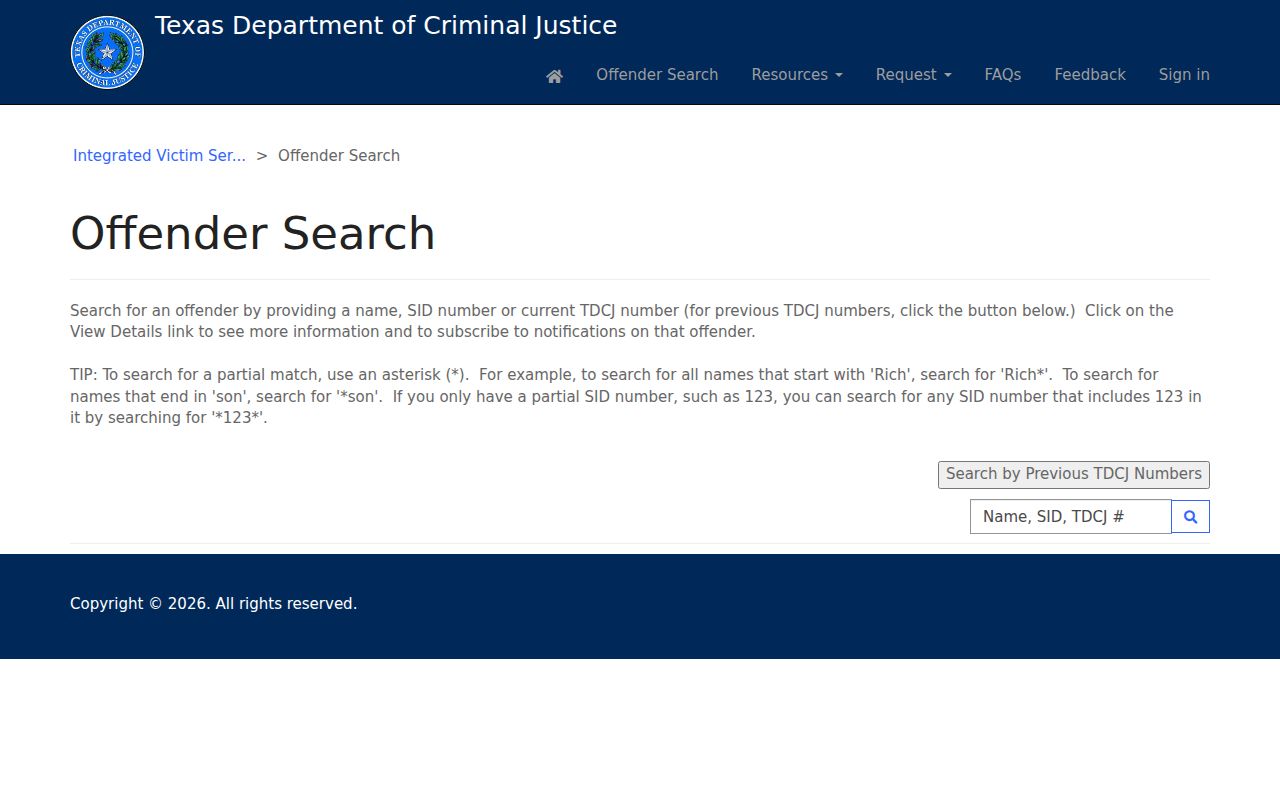
The screen illustrates the separation between a state custody lookup and other Bexar records. The Central Magistrate page is a recent-arrest feed covering roughly the preceding 24 hours, while the DPS registry is a separate statutory program. An arrest is not a conviction, and an official designation should not be expanded beyond its source.
San Antonio Family Record Leads
For family reconnection, estate work, and memorial research, older local collections can add context that a current index cannot. SAPL Texana/Genealogy has city directories, local newspaper microfilm, maps, clipping files, and staff reference. Its finding aids identify Cadena files, Hispanic history, land grants, deeds, probate, wills, churches, cemeteries, census material, and funeral programs. The African American Funeral Programs collection contains more than 1,000 programs from 1935 to the present and can provide names, relationships, congregations, service dates, and memorial locations.
Those sources should remain dated and separate from modern records. A 1912 address can be paired with a Sanborn sheet, city directory, County Clerk deed index, and City tax map. A historical name can be tested in a later city directory, newspaper, probate, and funeral-program source. The San Antonio Directory Book holds the collection-by-collection route for reading older directory entries and reverse address volumes.
San Antonio Record Limits
Texas public-record access has record-specific limits. The Texas Public Information Act, Government Code Chapter 552, governs disclosure with exceptions, and a general privacy request does not erase a County Clerk index, court docket, voter file, GIS parcel layer, or library item. BCAD offers a web-suppression form that removes an entire property record from its website, while the full appraisal record remains available through the applicable public-information route. Voter suppression and the Attorney General Address Confidentiality Program can replace or hide an address under their rules.
Sealed, juvenile, protected-victim, and restricted court material should not be inferred from an absence in the portal. County Clerk restricted records are excluded, and recent vital certificates require eligibility. Link to the custodian rather than duplicating sensitive fields. A wrong, stale, or suppressed record belongs with the agency that maintains it.
San Antonio Record Fallbacks
When the online index does not show enough, move to the record holder. Bring the case number and party name to a court counter, and ask whether a plain, certified, sealed, or image-only copy is available. Contact the County Clerk for a recorded instrument. Use City local registrar instructions for qualifying Bexar vital material and DSHS for statewide routes. For a library or archive gap, ask Texana/Genealogy, SAGHS, or City Archives staff for non-cataloged or physical holdings.
City open-records requests accept email, the Open Government Portal, mail, or hand delivery for existing City administrative records. A request should identify the name, address, date range, email, and subject or description. The City does not have to answer questions, perform legal research, or create a record. Court clerks remain the first route for judicial case files, and protected materials stay restricted.
Note: Preserve the official URL, record type, date searched, and field label with each result so another search can be checked later.