
San Antonio City Directories on Record
San Antonio directory research works best when the edition is tied to the repository that holds it. The local run begins in 1877, but no one shelf provides every year. San Antonio Public Library Texana/Genealogy has historical microfilm and book-form directories, while its historic-home material describes microfilm from 1877 through 1970 and hard copies from 1960 through 2009. Those are format notes, not a promise of uninterrupted annual publication. The Conservation Society holds directories from 1877 through 2002, though its catalog is incomplete. University, society, library, and online collections fill different gaps.
| Collection | Years | Where Held | Access |
|---|---|---|---|
| San Antonio Public Library directories | 1877-1970 microfilm; 1960-2009 hard copy notes | Texana/Genealogy | Library consultation and staff help |
| FamilySearch early microfilm | 1877/78 through 1895/96 examples | FamilySearch catalog, 68 reels | Cataloged microfilm |
| Conservation Society directories | 1877-2002, not every year | Conservation Society library | Confirm the incomplete catalog |
| Digitized Texas directories | 1850s-2022 collection span | Portal to Texas History | Free online items and date filters |
Trinity University adds a broad run with early, middle, and late twentieth-century editions, including Worley, Polk's San Antonio, and Polk cross-reference titles. The San Antonio Genealogical and Historical Society, or SAGHS, catalog also identifies examples from Polk, Southwestern Bell, and Cole. Check the edition itself before drawing a date conclusion, because gaps and publisher changes are part of the record.
San Antonio City Directory Shelf Work
SAPL Texana/Genealogy is the practical starting point for an old San Antonio address because it combines directories with newspaper microfilm, maps, clipping files, public genealogy computers, reader-scanner equipment, and staff reference assistance. During the listed renovation period, the sixth floor is closed and interim service is on the first floor across from main circulation. Its displayed hours are Tuesday noon to 8:00 p.m. and Wednesday through Saturday 10:00 a.m. to 6:00 p.m., with no Monday or Sunday service.

The service desk image matches the collection's role: directory research may require a reel, a book, a map, or a staff request rather than a single name field. Special-collection items, maps, clipping files, and microfilm may not be cataloged, so asking staff is a documented search step. SAGHS is another useful in-person route for vertical files, local obituaries, periodicals, maps, and family-history books; its library is open to the public, while remote vertical-file work has a $30 prepaid first-hour minimum.
For municipal material beside a directory, the City Archives has digital and physical collections. An appointment, first-visit form, photo identification, and the Archives' research rules apply to in-person work. Its finding aids cover NCB plat books, tax maps, public works files, mayoral records, maps, and planning records. Several thousand archive items are digital, but the City cautions that not every holding is online.
Digital San Antonio City Directories
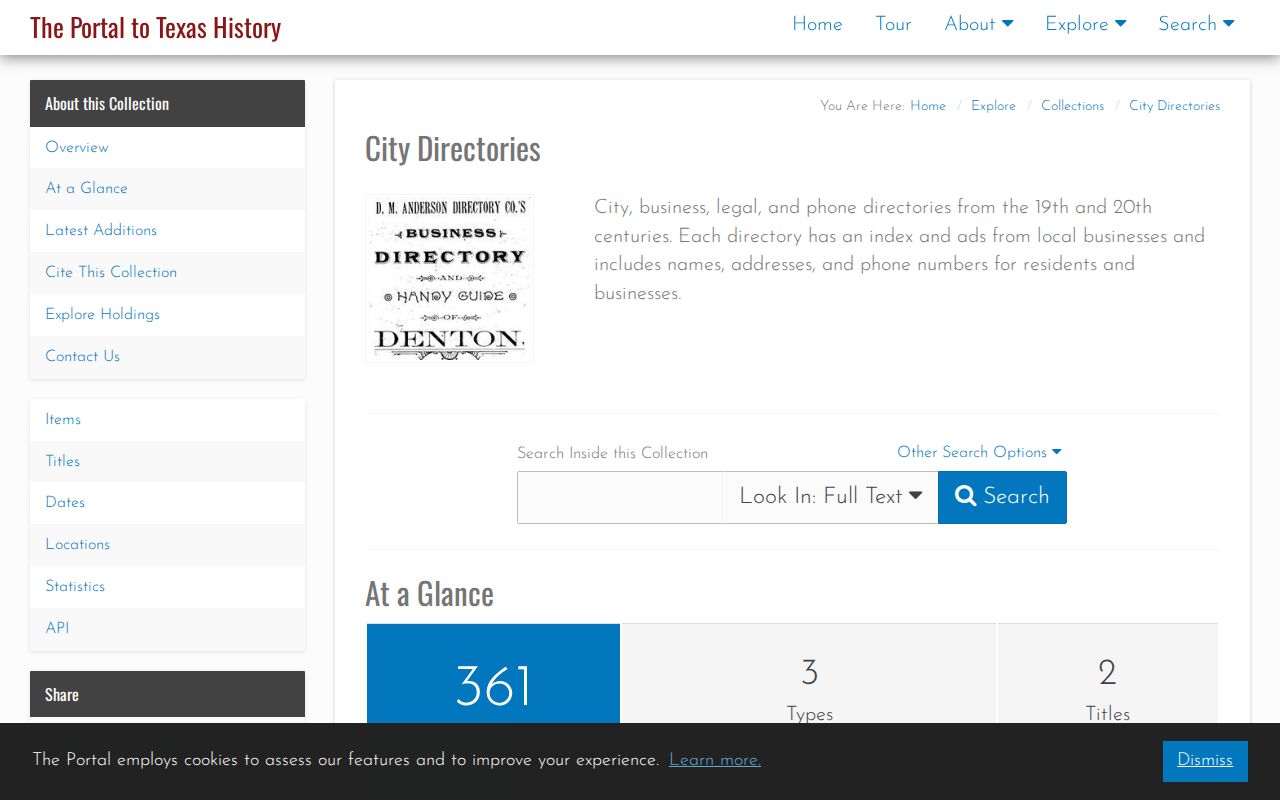
The Portal to Texas History directory collection offers 361 city, business, legal, and telephone directory items. Its collection spans 18 decades, from the 1850s through 2022, across 16 counties and 22 partners. Indexed names, addresses, phone data, and advertisements can make it a quick way to test a surname or business before planning a library visit. A date view, including the 1880 filter, helps keep a broad search from mixing eras.
Digital search saves time, but a match still needs an edition, page, and image number in the notes. A missing result may mean the target edition is on a local shelf, on microfilm, or in an unscanned collection. FamilySearch's catalog identifies Mooney & Morrison editions for 1877/78 through 1889/90, plus a Jules A. Appler 1895/96 listing. Trinity's holdings add many later years, while the Conservation Society can supply a different physical copy.
The San Antonio Archives Search is a companion source rather than a directory collection. It requires at least one word and accepts optional start and end dates. The archive recommends a date range of five years or less for speed, and its advanced search uses no more than two collection types. City deeds, tax maps, engineers' maps, birth and death collections, minutes, ordinances, and election results can test a directory lead against a dated municipal record.
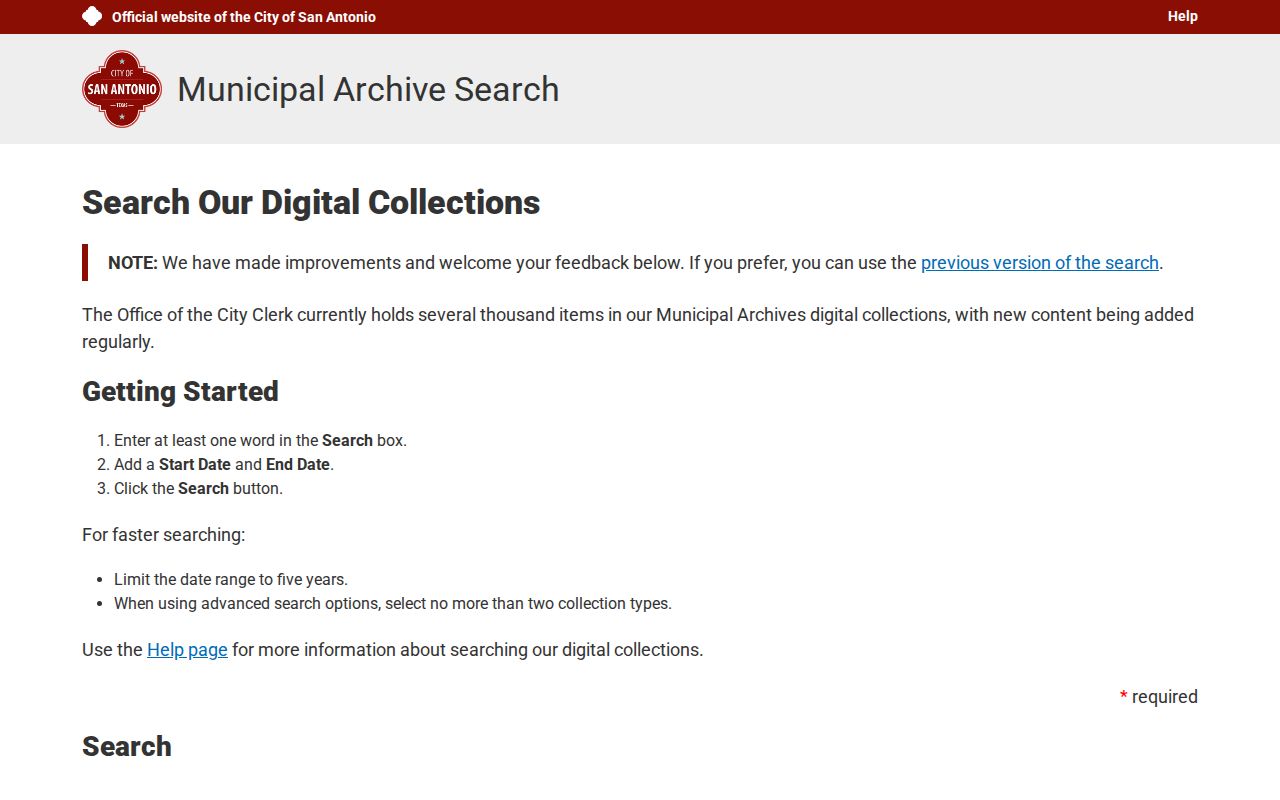
The Archives screen is a useful reminder that a catalog hit is not always an online image. Use the finding aid, then request physical or non-digitized material from archive staff when the search returns only a description.
Read a San Antonio Directory Entry
A city directory entry should be transcribed before it is interpreted. Capture the exact surname spelling, initials, honorific or household role, occupation, business name, street, house number, and edition year. A directory may also distinguish a residence from a business, show a boarder or a widow or widower, or include telephone information. Those marks vary by volume, so the abbreviation key in the same edition matters more than a modern assumption about the mark.
| Name and initials | Exact indexed form, including variants and household role where printed |
|---|---|
| Trade or business | Occupation or enterprise clue, when the edition includes it |
| Street reference | House number, street, intersection, residence, or business notation |
| Household clues | Boarders, widow or widower notation, and telephone details only where printed |
| Edition reference | Repository, year, page, and image or reel number for later checking |
- Criss-cross directory
- A reverse directory arranged by street name and house number rather than by a person's name.
- Householder index
- An index that identifies a household or named resident in the arrangement used by that volume.
- Abbreviation key
- The volume's explanation of its short forms. Photograph or note it before treating a mark as evidence.
One documented 1877 example shows the value and the limit. A Texas Historical Commission National Register form cites John August Heidgen on page 37 as a bakery and confectionary worker with a residence at Elm and Travis. That gives a name, trade, and residence clue, but it does not prove title, length of stay, or every household member.
San Antonio's Blue Book Route
The Blue Book is a local reverse tool for when the household name is unknown. The historic-home resource describes it as an original criss-cross directory organized by street and house number, sometimes with phone information. Cole cross-reference volumes serve a related purpose. Start with the street spelling and number as printed, then use a conventional name directory or newspaper microfilm to test the lead. A reverse volume does not remove the need to compare years.
Address history can interfere with a direct lookup. Acequia Street became Main Avenue in 1891, so old deeds, newspapers, and directories may use either name. The City divides its street grid at Commerce Street and the San Antonio River, with odd and even numbers on different sides. A historical address without a direction can therefore be ambiguous. For older blocks, the City Archives' 154 NCB plat books, with roughly 100 pages each, add a block and street route; NCB 1100 and higher have a separate image-request limitation.
Note: Preserve old street names, directionals, and edition years in the search notes before converting an address to a modern format.
San Antonio City Directory Dates
Directory work gains strength when it follows the custody of the supporting records. The first documented local directory era begins in 1877, the same year railroad arrival accelerated business and address changes. City deeds and engineers' maps cover 1847 through 1929, City Block Tax Maps and red books cover 1898 through 1990, and the 1912 Sanborn volume supplies building footprints and uses. These sources overlap, but each makes a different claim about a person or place.
- 1877: documented first local city-directory era and the Heidgen entry.
- 1898-1990: City Block Tax Maps and red books provide block and street continuity.
- 1912: the Sanborn San Antonio volume adds building and address context.
- 1955-1964: City Property Appraisal Survey records add a municipal layer.
- 1961/1962: Bracey's Block Maps bridge owner, lot, block, and changed city numbering in north San Antonio.
- 2021 onward: county preservation work has made more historical material searchable in Vanguard.
Use a Sanborn sheet with a directory when the question concerns a building or a number, not merely a surname. The Library of Congress Sanborn volume has 87 sheets in an 86-image sequence. Bracey's Block Maps are especially useful north of the city because they show owners, dimensions, lots, blocks, and new city block and street numbers, abstracted from 1961 City Tax Office material.
Trace Families in San Antonio Directories
Following a household through annual volumes requires a date matrix, not a single successful search. Read at least two editions around the target date. Pair the entry with a census, deed, tax map, newspaper, probate record, funeral program, or map according to the question. For an old land lead, the Bexar Spanish Archives covers colonial and Mexican material, including land transactions from 1736 through 1837, while the County Clerk deed database continues the land trail after 1837.
- Find the surname in a target-year directory and record its exact form, page, street reference, and trade detail.
- Read an earlier and a later edition to identify a move, a changed listing, or a gap.
- Check the Blue Book or a Cole cross-reference by street and house number when a name search fails.
- Pair the directory year with census, map, deed, newspaper, probate, or vital evidence that can answer the remaining question.
- Record each source separately as an address association, recorded party role, or map observation instead of combining them into one claim.
A disappearance may reflect a move, death, an unlisted household, a changed spelling, or an unheld edition. It is not proof by itself. SAPL's African American Funeral Programs collection, with more than 1,000 programs from 1935 to the present, is a strong family and memorial-research companion for names, relationships, congregations, service dates, and memorial locations. Local newspaper, cemetery, church, and obituary material is not gathered in one San Antonio portal, so use SAPL or SAGHS reference staff for the relevant collection.
San Antonio Directory Gaps
These volumes are strongest as a dated address association. They do not establish continuous occupancy, title, or a complete list of everyone at a location. City limits, street changes, patchy runs, and a difference between a catalog description and an online scan can all explain a failed search. A post-1980 address may have GIS, tax, parcel, or digitized city and county material, but many historical images remain offline.
When an online search stops short, use the fallback chain documented for San Antonio: confirm the library shelf or reel with Texana/Genealogy staff; consult SAGHS or the Conservation Society; use the City Archives finding aid and make an appointment for physical material; then request an existing city record through the City open-records route if that is the proper custodian. Texas Public Information Act requests can be made to the City by email, portal, mail, or hand delivery, but the City does not have to answer questions, perform research, or create a new record.
Modern address-keyed sources are intentionally separate from this historical shelf. For current parcel and street investigation, use the San Antonio Street Directory route after the historic street name and number have been normalized.