
Finding San Antonio Residents
San Antonio has no single public list of every household. For a present address, begin with the Bexar Central Appraisal District parcel tools and note the situs address, property ID, owner field, and legal description. For a recorded property connection, move to the County Clerk index. For a past household, start with a directory year and the address as it appeared at that time. Each record has a different purpose, so an owner field, a voter registration result, and a city-directory entry should never be treated as the same claim.
The useful trail is usually short when the search starts with a precise fact. A current street address can become a parcel identifier, then a legal description, then a deed search. A full name can be checked in the court portal and compared with an address or case number. Old addresses call for directories, maps, and archive staff rather than a modern search box.
- Normalize the street number, direction, street type, ZIP, and any old street name.
- Search the BCAD map or parcel layer for the situs address and property identifier.
- Use the legal description or party name in the County Clerk land-record index.
- For a single voter record, use the Bexar form with date of birth, house number, and last name.
- For an earlier household, compare two nearby directory years and then check maps, deeds, or probate material.
Note: A record can show an owner, a party, or a directory resident without proving present occupancy.
San Antonio Records Offices
Bexar County divides the core work among several custodians. BCAD maintains appraisal parcel information, the Tax Assessor-Collector handles tax accounts, and the County Clerk maintains recorded land records. Elections has the individual voter-status route, while the City Archives holds municipal maps, deeds, minutes, and physical holdings. The office choice matters because a parcel page is not a deed and a tax account is not an appraisal.
When an index lacks an image or an older series is not online, use the specific Clerk counter, then a library or archive search, before making a focused request for an existing releasable record. The County Clerk notes that online search, copies, and e-filing are separate services.
San Antonio Parcel Search
The BCAD map is the practical first stop for a street or property question. Its Text Search accepts a whole or partial person or business name, a property street address, or a street name. It also offers neighborhood, subdivision, Mapsco, radius, map-analysis, and export controls. Results are capped at 1,000 rows, so a long street should be narrowed by house range, subdivision, neighborhood, or radius before the result table is used.
| BCAD field or tool | Use for a San Antonio search | Limit |
|---|---|---|
| Property account number | Open a known parcel | Positive integer, up to 10 digits |
| Text Search | Name, address, or street term | Broad terms can exceed the result cap |
| Neighborhood or subdivision | Reduce a broad street result | Selections require a search run |
| Radius and map analysis | Review a defined local area | Map and table are separate views |
The Bexar County Public Record Search information page shown below explains the county’s free record-search route. Use a property ID from BCAD as a pivot, not as a conclusion about every person connected with a parcel.
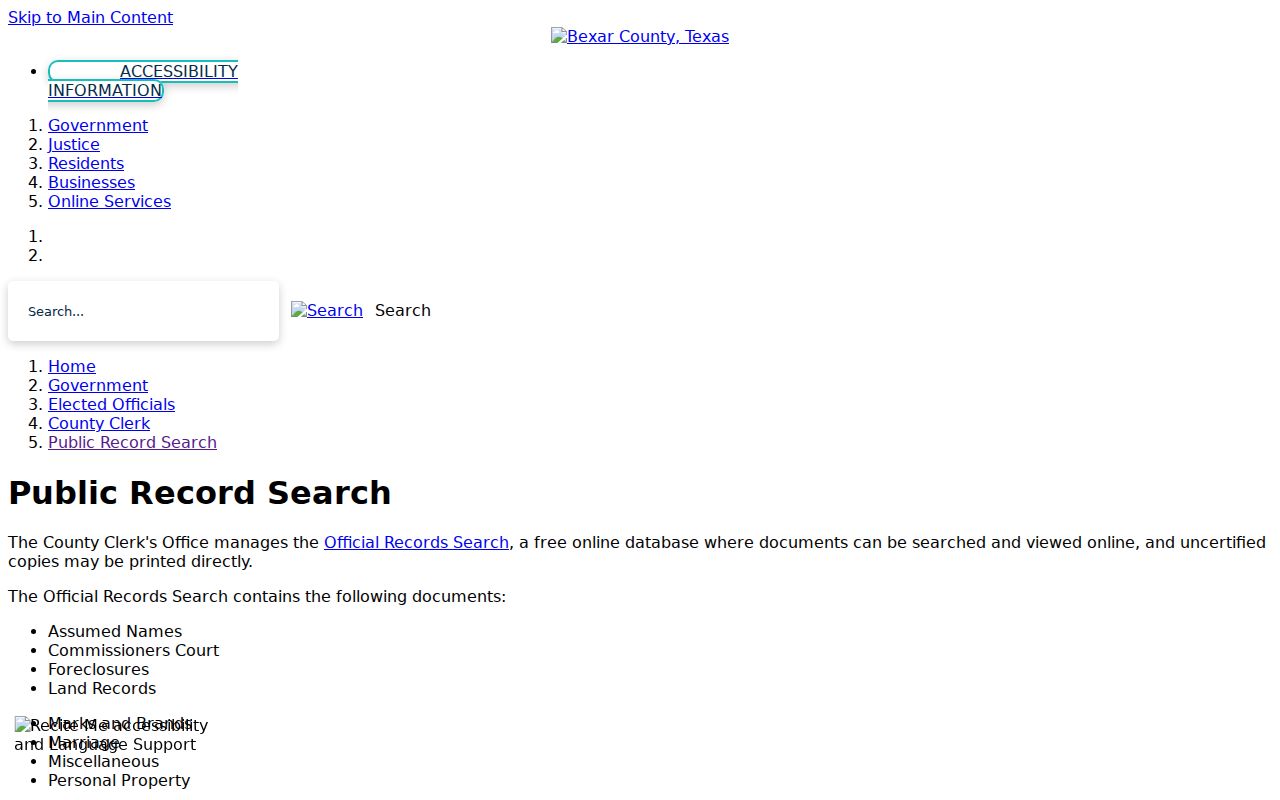
The county explains that public records can be searched and viewed without charge, with uncertified copies printable where the collection allows it. A certified copy follows a different Clerk route.
Bexar Deeds for San Antonio Names
The County Clerk portal separates departments before it searches. Land Records, Plats, Assumed Names, Marriage, Commissioners Court Minutes, Foreclosures, Public Notice, Personal Property, Spanish Archives, historical series, and other collections have distinct indexes. In advanced search, party names, grantor, grantee, instrument date, document number, lot, block, NCB, legal description, property address, and document-image terms provide ways to narrow the result.
A grantor transfers an interest named in a recorded instrument; a grantee receives it. Those labels help trace a title chain, but a result still needs its date, legal description, and instrument number checked. Start with the current grantee and work backward to a prior grantor. For a missing image, retain the document number and ask the Clerk which counter or copy route applies.
- Parcel
- A mapped unit of property used by an appraisal system.
- Situs address
- The physical location assigned to a parcel, distinct from a mailing address.
- Legal description
- The lot, block, NCB, or other formal land description used to match records.
- Index
- A search list that points to a record; it is not necessarily the full document image.
The Bexar Official Public Records portal is shown in this quick-search capture.
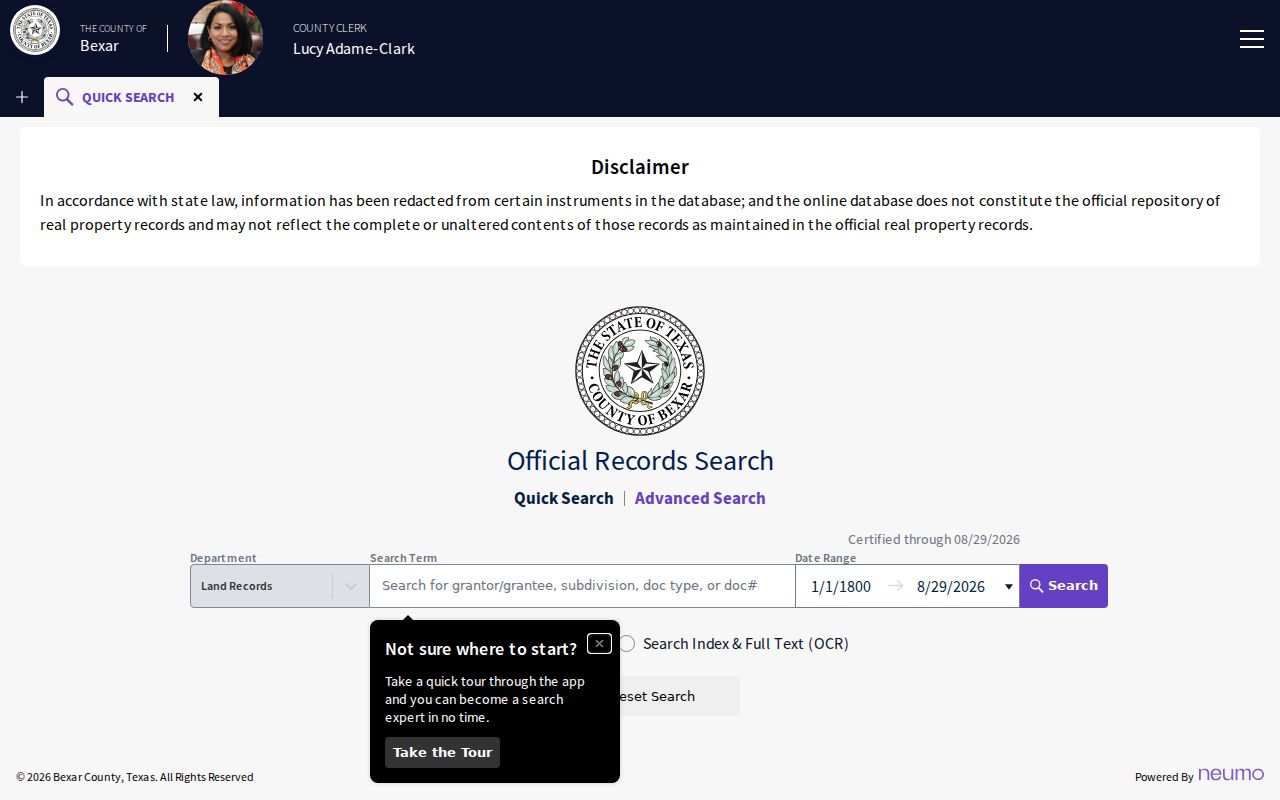
Choose the department first, then use a party name, address, legal description, or recording detail that belongs to the question.
San Antonio Voter Record Check
Bexar’s individual voter lookup is deliberately narrow. The visible form asks for date of birth and house number before last name, then returns a registration-status, registered-address, precinct, and election-information result where the record may be released. It is not a street-wide or ZIP-wide roster. The statewide “Am I Registered?” route is a separate check that uses VUID, driver-license number, or name options.
The Bexar Voter Registration Search capture shows the county route. Treat a protected or missing address as an access limitation, not proof that someone is absent from San Antonio. Texas rules also protect fields including Social Security numbers, driver-license information, and voter phone details.
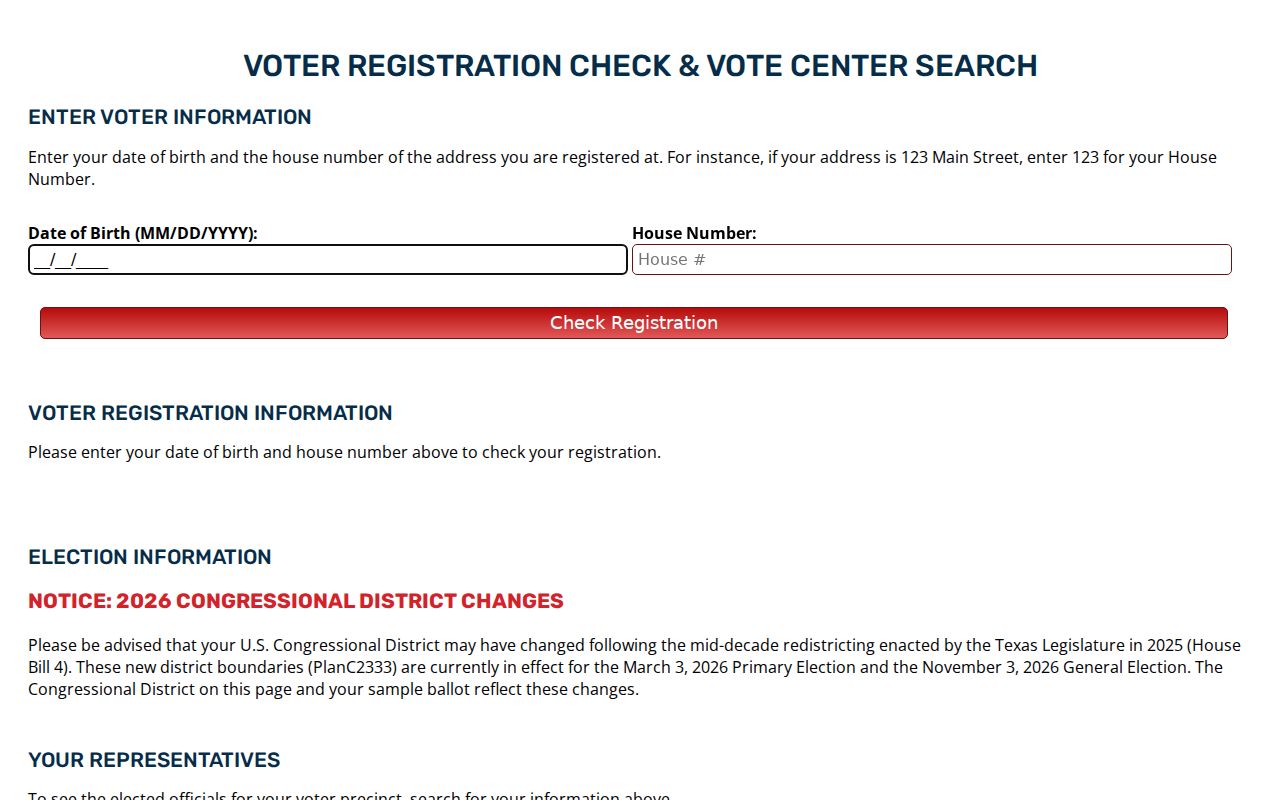
Use the form only for the individual record it is designed to check, and preserve the distinction between voter registration and occupancy.
Note: Texas address-confidentiality programs can change what an otherwise public lookup displays.
Current San Antonio Resident Directories
Current directory-like sources in San Antonio are record-specific, not interchangeable. The value of a source comes from its field labels and custodian. BCAD offers appraisal attributes, the Clerk shows recorded parties, the voter form returns an individual registration result, and a court portal identifies case participants. Match the source to the question, then verify a name match with an independent record.
| San Antonio source | What it identifies | Custodian | Access route |
|---|---|---|---|
| BCAD parcel record | Owner, situs, mailing and legal fields | BCAD | Map or parcel service |
| Recorded land index | Grantor, grantee, instrument and date | County Clerk | Official Public Records |
| Voter registration result | Registered address and precinct where available | Bexar Elections | Individual lookup |
| Justice case result | Party, case, status, and event information | Bexar courts | Tyler portal |
| Historical directory | Name and address association for an edition | SAPL and partner collections | Library, microfilm, or digital collection |
A modern person-focused question can move to the San Antonio resident lookup workflow, where court, vital, and identity matches are separated more closely.
San Antonio Justice Portal Matches
Bexar’s New Justice Information Portal consolidates older case, fugitive, and bail-bond search routes. Its public side offers Smart Search, hearings, jail search, and payments without a public account. Smart Search accepts a record number or name, while advanced controls include party name, business name, nickname, phonetic matching, FBI, SO, or booking number, case type, case status, file dates, and judicial officer.
Case number is much stronger than a common name. The portal’s public-data notice says results can be incomplete or not current, and its result cap is 200. Municipal cases and upcoming dockets use a separate City Court route, while District Clerk and Probate records have their own custodial paths.
The Bexar justice portal capture shows the public search choices.
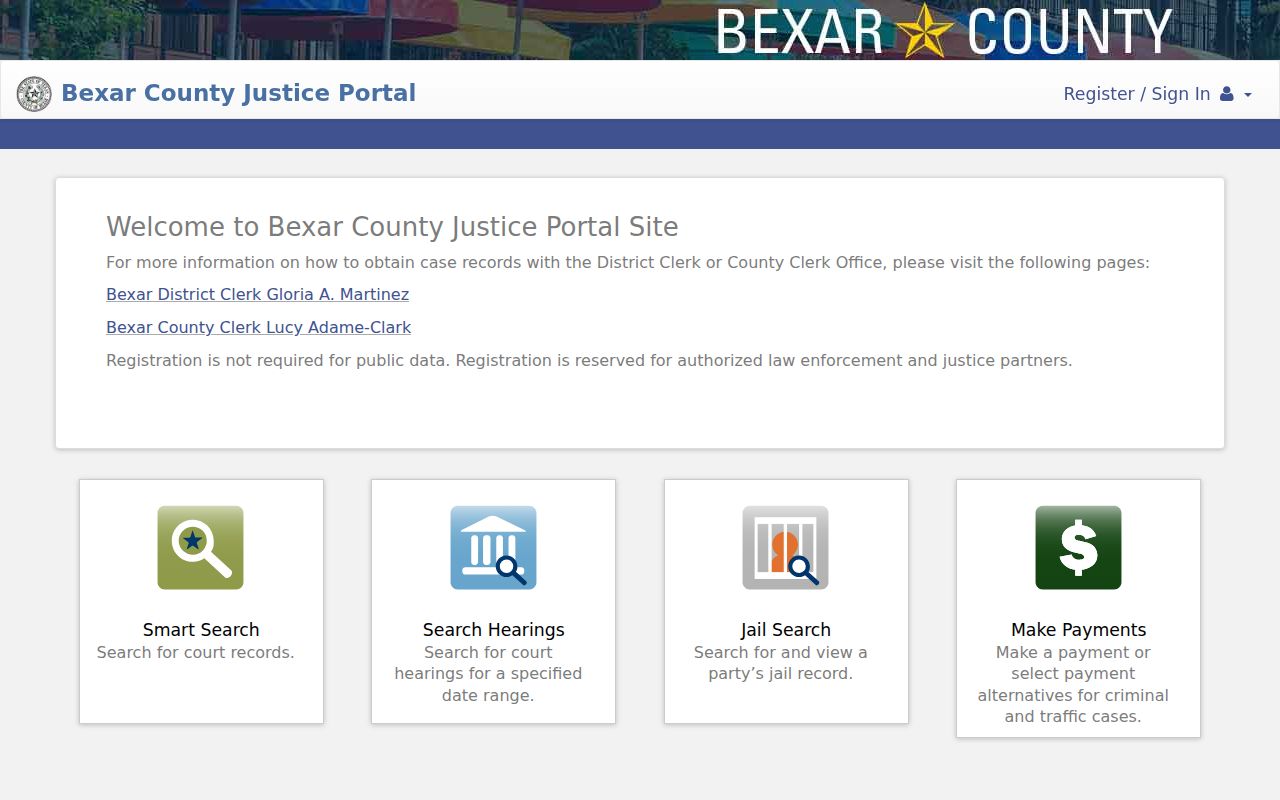
Record the case number, case type, party role, and date before asking the appropriate clerk about an official copy or status.
San Antonio Vital Record Routes
San Antonio’s local registrar and Texas DSHS hold different vital-record material. City archive collections list births from 1896 to 1936 and deaths from 1873 to 1926, while the local registrar describes birth coverage from 1897 and death coverage from 1873. Keep those labels tied to the collection being searched instead of turning them into a single claimed cutoff.
Texas Government Code §552.115 opens public historical birth records after 75 years and death records after 25 years. That rule does not bypass the eligibility, identity, and relationship requirements for recent certified copies. DSHS offers statewide procedures and orders; the city handles its own local route. A public index and a certificate answer different questions.
San Antonio Archive Searches
The City Archives digital search accepts at least one word, plus optional start and end dates. It recommends a date range of five years or less and allows no more than two collection types in an advanced search. Its collections include City Block Tax Maps and red books from 1898 to 1990, City deeds from 1847 to 1929, City Engineers Maps, birth and death series, minutes, ordinances, and election results.
Not every catalog item is an online image. The San Antonio Archives Search can be followed by a finding aid, an appointment, and staff help for physical material. The Archives requires an appointment for in-person research, a first-visit form, and photo ID. Its NCB plat finding aid covers 154 books with roughly 100 pages each, while NCB 1100 and higher can require an image request.
San Antonio Directory History
San Antonio city-directory research begins with the 1877 era, but each repository holds a different run. SAPL describes historical microfilm and book-form directories in overlapping format ranges, including 1877 to 1970 on microfilm, hard copies from 1960 to 2009, and an incomplete Cole run. Its current Texana/Genealogy service is on the first floor during sixth-floor renovation, with microfilm readers, scanners, public computers, maps, newspapers, and staff reference help.
The Blue Book is the local criss-cross directory, organized by street name and house number. It helps when the address is known but the historical name is not. A city-directory entry can link a name, address, occupation, or business to one edition. It does not prove title or continuous residence. The San Antonio city directory collections give the shelf, publisher, and year-run detail.
Note: Ask library staff about uncataloged maps, clippings, microfilm, and the gaps between printed directory editions.
San Antonio Family Memory Files
For family history, the Texana collections add material that a parcel or court search cannot provide. The African American Funeral Programs collection has more than 1,000 programs from 1935 to the present and can provide names, family relationships, congregations, service dates, and memorial locations. Local archival files also cover cemeteries, church records, marriages, deaths, deeds, probate, military material, maps, and family-group sheets.
The San Antonio Genealogical and Historical Society has Texas directories, periodicals, vertical files, historical maps, and family-history books. Its library is open to the public, and its remote vertical-file service accepts prepaid research requests. Compare every family clue with the record type that supports it, such as a probate file, death index, deed, directory year, or newspaper notice.
Spanish Archives Before San Antonio
Bexar County’s Spanish Archives extend the local record trail well before modern city systems. The archive holds Spanish colonial and Mexican-era material, with land records from 1736 to 1837 and wills and estates from 1724 to 1870. Those sources may preserve names, land grants, mission references, estates, and language variants that will not appear in a modern parcel card.
The Bexar County Spanish Archives is an appointment route. After 1837, land transactions generally pivot to the County Clerk deed database. Keep original spelling and translated variants in a search log, and compare the date with the custodian change before deciding where to search next.
San Antonio Record Request Routes
When a public portal does not show the needed record, ask for the existing record held by the office, not a new list of residents. The Texas Public Information Act, Government Code Chapter 552, generally does not require a reason for a request, but it does require enough detail for the custodian to locate the record. Give the name, address, date range, identifier, and desired format. Ask whether a releasable or redacted copy exists when a full record is restricted.
San Antonio accepts open-records requests through email, its Open Government Portal, mail, or hand delivery. The city says it need not answer questions, perform legal research, or create a record. County requests should go to the division that actually holds the record, and statewide vital, voter, custody, or license questions belong with the corresponding state custodian. An estimate is required when expected charges exceed $40 under the state guidance.
San Antonio Safe Research Checks
Use the smallest field set needed and label the role accurately: owner, grantor, registered voter, directory resident, court party, or association contact. Do not combine those labels into a claim that a person currently lives at an address. Texas programs can suppress voter addresses or BCAD web display, and restricted court, vital, and juvenile material may not appear in a public result.
| Official record route | Best use | Check before relying |
|---|---|---|
| Parcel and GIS | Property and mapped address fields | Situs, owner, and mailing fields mean different things |
| County Clerk index | Recorded property trail | Instrument image, legal description, and date |
| Court portal | Case identity and status | Case number and court clerk |
| Library or archive | Historical address association | Edition, page, and supporting source |
Lawful use. San Antonio records are for personal, lawful research and source verification. Do not use a record or lookup to stalk, harass, threaten, or harm anyone.